
WORK
Cutting-edge advances for farming to education
The economy of East Williamson County is changing fast with new jobs coming from data centers to support the vast information-storing needs of artificial intelligence to a Samsung Austin Semiconductor foundry producing the chips that make artificial intelligence, robots and automated automobiles possible.
That same technology, however, is changing the way even traditional jobs in the region are done. What does the future of work look like for old-school jobs?
East Wilco Insider talked to local experts about how the present and future of farming, education, building and medical professions are undergoing radical changes.
FARMING
Driving the main roads in East Williamson County, it is easy to believe that every acre of farmland is disappearing to industry and new neighborhoods. Not far off those well-traveled roads, however, there is still plenty of corn, cotton, hay and other crops that have been the backbone of commerce for generations.
What is changing is how cultivation is done as small Blackland Prairie farmers and ranchers look to technology to keep an edge to remain profitable.
“It’s not clear to me if (technology like AI) all will be beneficial. Certainly, in farming, a low-margin business, efficiencies are important,” said Ryan Collett, farm manager of the Stiles Farm Foundation in Thrall.
The 2,700-acre experimental farm is operated by the Texas A&M AgriLife Extension Service and is behind cutting-edge crop research and cultivation techniques that have improved the work of farmers.
Using computing power to help predict how early corn can be planted without damage from cold can make a big difference for farmers.
“The quicker you can get your corn in, the more you can avoid the summer heat,” Collett said.
Planting technology also plays a role in getting crops in faster and better. That includes new planters that provide greater speed and uniformity doing 24 rows at a time instead of the old standard planter that does 12 to 16 rows at a go, he said.
Stiles Farm also is involved in testing John Deere’s autonomous farm equipment at a site in Coupland.
While it isn’t planting and bringing crops to life, the software for the self-driving and operating farm equipment is getting a rigorous shakedown before it becomes part of the future of farming.
Collett said drones also are changing the the profession when it comes to treating and analyzing crops.
A recent infestation of thrips in a cotton field at Stiles Farm threatened the crop unless the miniscule, plant-sucking insects were dealt with quickly. Wet conditions, however, prevented traditional groundbased treatment so a special drone service was called in to apply the pesticide from the air.
Capturing crop data with drones also will help with analysis and figuring out what treatments or adjustments need to be made One such application is the ability to see chlorophyl levels, which can be an indicator of plant stress, Collett said.
Of possible benefit to Central Texas farmers applying AI in the future is the ability to analyze more soil samples per acre and large amounts of data quickly.
“At the end of the day, people need to eat,” Collett said. “I’m hoping these technologies will help the Central Texas farmer we serve.”
EDUCATION
In 17 years in public education, Kelly Hong has watched the tools for teaching change in dramatic ways. As the Hutto Independent School District director of instructional technology, she is now helping shape the way high-tech tools are used in and outside the classroom by teachers and students.
The future of teaching is already here with multiple technologies enhancing the work of the teacher for better outcomes with AI tutoring, virtual-reality learning and real-time video chats with people across the planet.
“We can’t ever replace the teacher, but at the same time they’re getting additional help,” Hong said.
During lessons in Hutto schools, students use Chromebooks during lessons to supplement what the teacher is saying and get real-time feedback. That extends beyond the classroom with AI tutoring on demand.
There are strict limits on how AI can be used by students and how much teachers can use it in the classroom under a specific new district policy, Hong said. For example, students can’t use AI to generate their homework, but they can use it to create question-and-answer formats and study guides to prepare for tests.
The policy limits the use of AI and other technologies in the classroom to no more than 20 minutes per educational block and can only be used to enhance the lessons, Hong said. Hutto ISD uses software that gives data analysis of who is using the AI and other tech tools, and how and how much they are using it, she said.
Beyond AI and other learningenhancement software, the ability to connect virtually by live video to anywhere in the world has led to classroom discussions with authors whose works the students are
“We can’t ever replace the teacher, but at the same time they’re getting additional help,”
— KELLY HONG,
HUTTO ISD DIRECTOR OF INSTRUCTIONAL TECHNOLOGY reading and seeing far-flung places to bring learning to life.
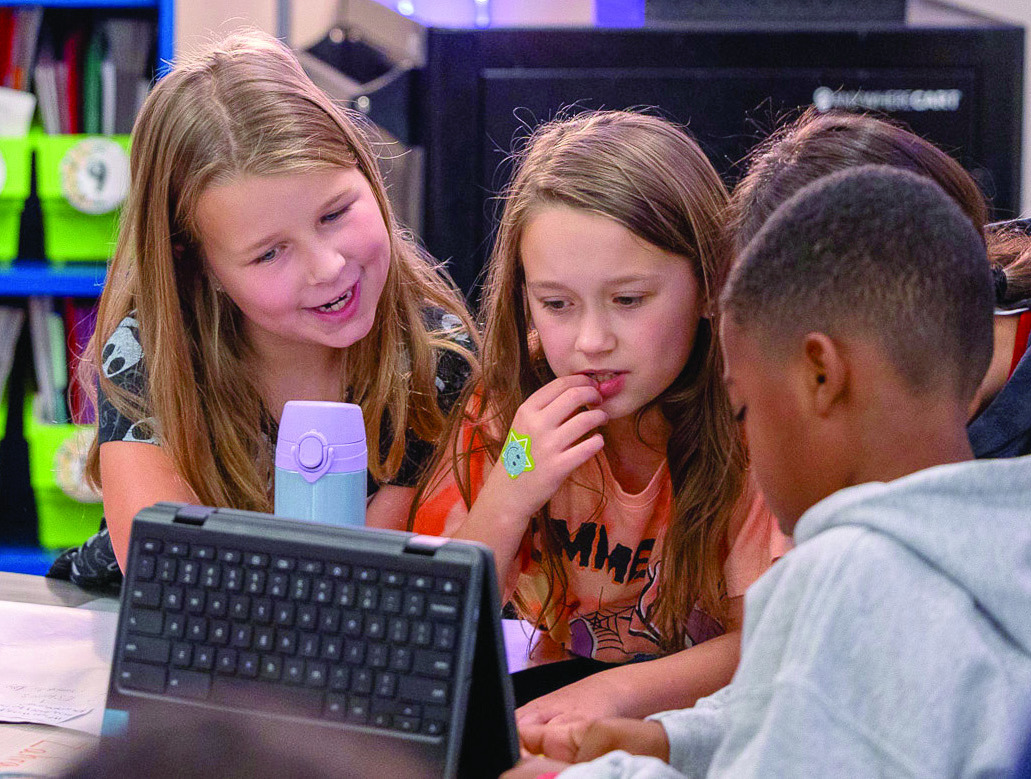
Students at Hutto Independent School District’s Veterans Hill Elementary School use videos and other computer-based tools to enhance learning. PHOTO COURTESY OF HUTTO ISD
The new school buildings are designed to adapt to what might come next, such as including space to develop and test robotics projects.
Hong said virtual-reality goggles also have been adopted for science, technology engineering and mathematics, or STEM, subjects and even training for trades.
The auto shop uses virtual-reality headsets and motion sensors to let students do things such as practicing changing oil in a vehicle without wasting a drop of pricey 10W-40 before doing it for real
BUILDINGTRADES
Building houses and commercial buildings is a job that has been changed by technology more than a few times over the centuries: hammers replaced by nail guns, handsaws usurped by battery-powered whirring blades and string lines giving way to lasers.
The need for housing is greater than ever as populations boom in several Central Texas cities. Observers say it will take a combination of people power and technology to meet that need.
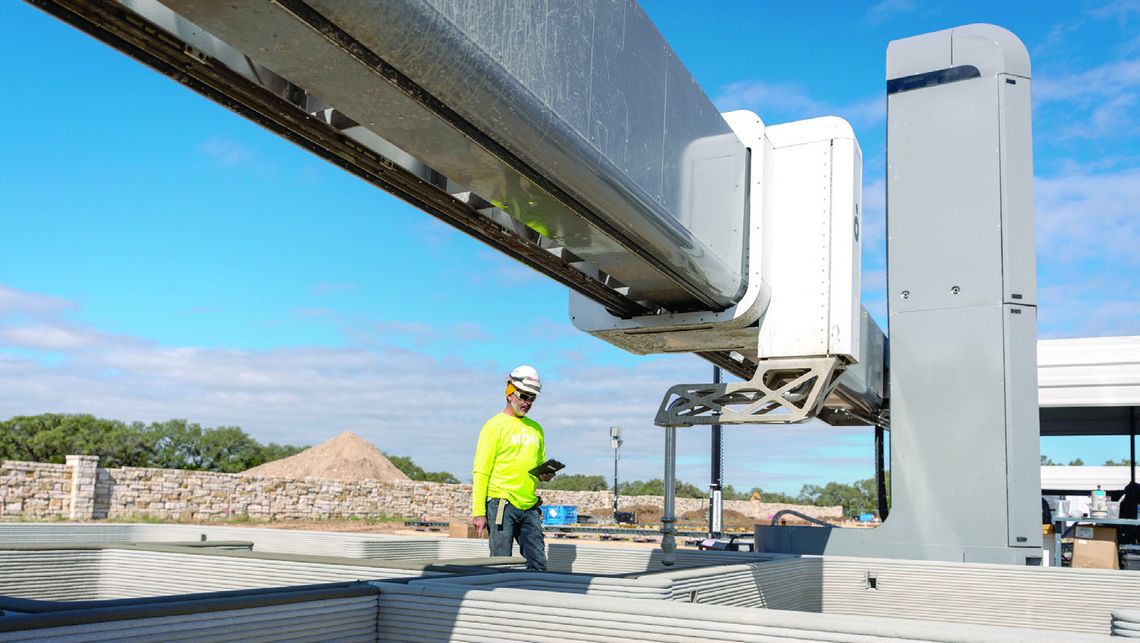
More changes are likely to come as AI streamlines processes; robotic tools do the work of prefabrication offsite and 3D printing an entire house is no longer a work of science fiction.
David Downs, a leading custom builder based in Taylor, said technology has transformed the design work of the houses he builds with software that lets clients see their custom home in a 3D walkthrough that helps them get a feel for the property much better than just seeing twodimensional schematics on a blueprint.
Materials too are changing. Downs points out a builder using robots to create the walls of 3D “printed” houses made from layer after layer of concrete in the Georgetown area. Another is using the versatile and tough hemp crop to make sturdy “hempcrete” as a building material.
The Wolf Ranch development in Georgetown includes 100 houses created with Icon Technology Inc.’s massively scaled up 3D printer that uses special concrete.
A study from global consulting firm Deloitte found that AI for decision-making, drones for monitoring work and more offsite modular construction are a big part of the future of building.
According to Deloitte’s “The Future of Construction” report, the industry is “likely to incorporate more digital technologies into key workstreams to further enhance productivity, efficiency and worker safety. These changes make it important for (engineering and construction) firms to start thinking of how roles and jobs might change to reflect the use of these new technologies. For instance, many E&C firms are today looking to hire more data scientists and software developers than traditional engineers.”
MEDICALPROFESSIONS
Telemedicine, which had been around for years, reached new heights during the pandemic as the medical community scrambled to find ways to help as many patients as possible without risking infection for the patient or from the patient.
At the time, it seemed it felt like the future for those who hadn’t experienced saying “Aaaah” while opening wide to the video camera on a smartphone or PC. It turned out that acceptance of telemedicine was just the tip of the iceberg when it comes to game-changing technology that affects the future of how nurses, nurse practitioners, physician assistants and doctors do their jobs.
“As we navigate a rapidly evolving health care landscape, the integration of AI into clinical practice holds tremendous promise,” said Tracey Smith, director of the Doctor of Nursing Practice program at Texas State University’s St. David’s School of Nursing in Round Rock. “From predictive analytics to personalized care, AI is transforming how we deliver and experience health care. However, with this innovation comes responsibility.”
Smith said the rise of AI-generated misinformation, sometimes referred to as “hallucinations,” poses real risks to public health.
“That’s why health care education today must go beyond clinical preparation. It must also empower providers, students and communities to evaluate information critically, distinguish fact from fabrication, and make informed decisions that protect health and safety,” Smith said.
While AI has limitations when it comes to 100% accuracy in answering questions in the form of prompts, it is immensely useful for analyzing large amounts of data quickly.
“We’re already using AI to look at MRIs because it can recognize abnormalities faster than a human can,” Smith said.
Chatbots can help in some things like mental health, she said, but shouldn’t be used to replace human counseling.
The technology “will get better. It is not without fault, but neither are humans. We have to find a way to harness it because it’s not going to stop,” Smith said. “I’m proud to lead a team that not only prepares nurse practitioners and nurse leaders to deliver exceptional care but also equips them to lead with integrity in an age of digital complexity.”
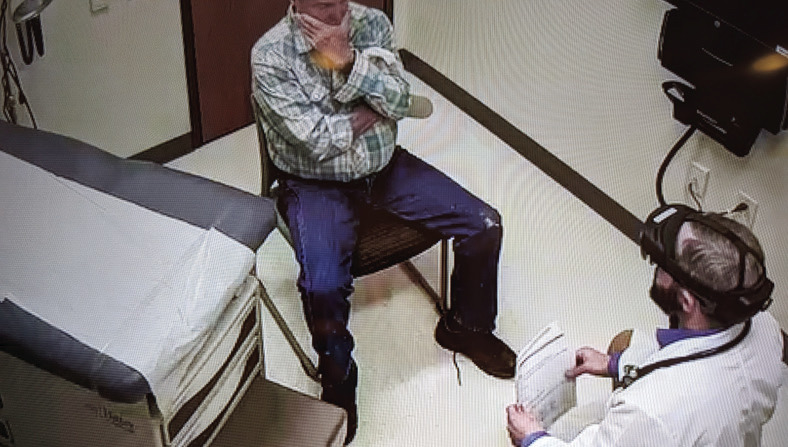
A primary-care nurse practitioner student role plays with an actor posing as a patient while consulting virtually with a psychiatric mental-health nurse practitioner using an augmented reality headset at St. David’s School of Nursing at the Texas State University campus in Round Rock. PHOTO COURTESY OF TSU

Comment
Comments