
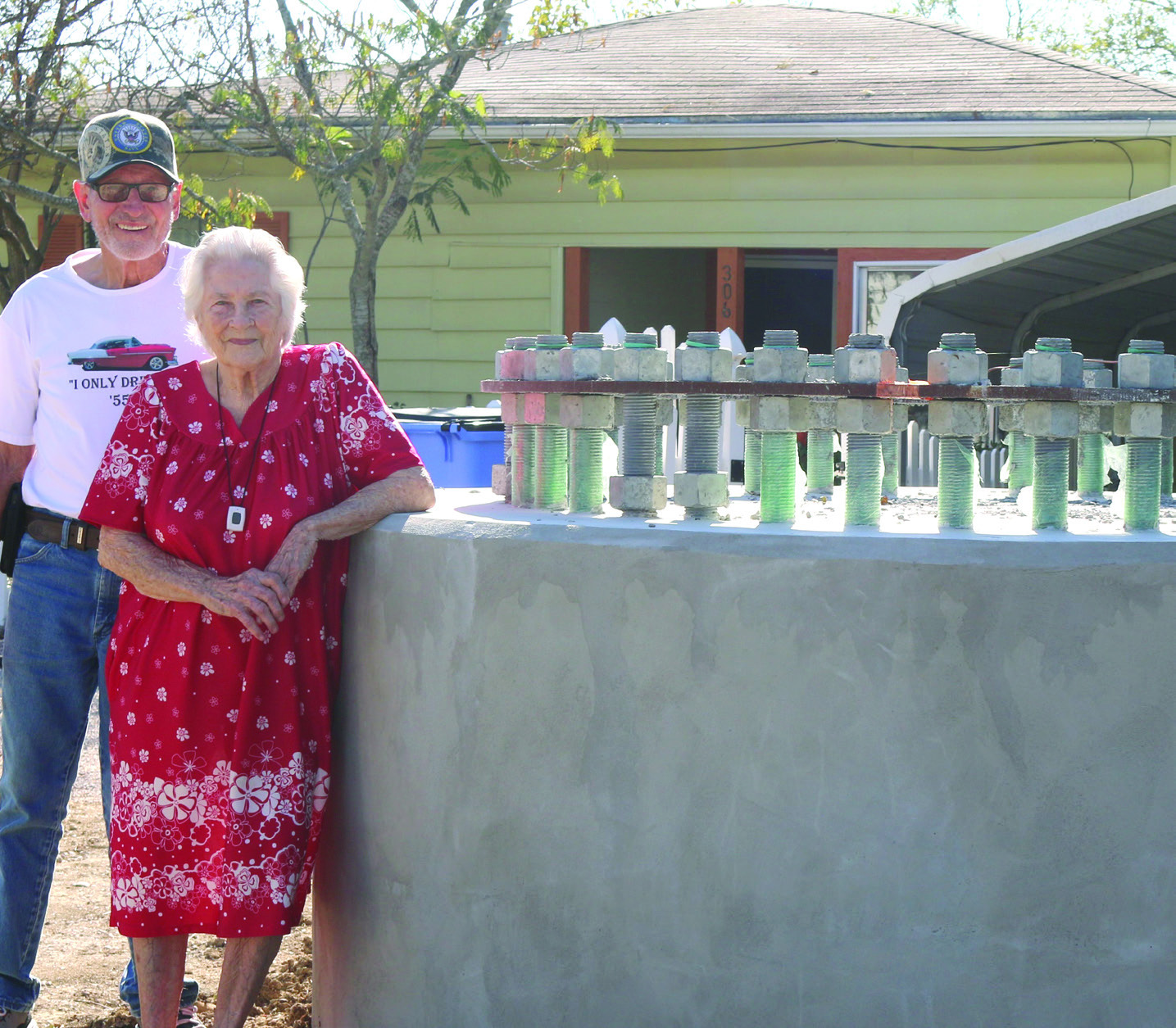
TAYLOR — For almost 70 years Lilian Fox, 91, has sat on her porch and enjoyed the view of her quiet Taylor neighborhood. Dominating the landscape was a mature catalpa tree, planted when Lilian and her husband, Joe, built their home in the former cotton field that is now Old Thorndale Road.
Today, that shade tree is gone, to be replaced by a 100-foot-tall concrete and steel transmission pole being installed by Oncor Electric Delivery Co. as part of a system upgrade.
The installation of the poles across Taylor has sparked concerns, including from Mayor Dwayne Ariola and others. Fox said she sympathizes.
“I’m glad I’m not driving anymore because I don’t think I could back out of my driveway with that there,” Fox said about the large concrete base built to support the new pole.
In addition to the beloved catalpa tree, Fox said utility company workers removed some hedges.
“I have people asking me all the time what I’m being paid. I’m not being paid. I couldn’t put a price on it anyhow,” she said.
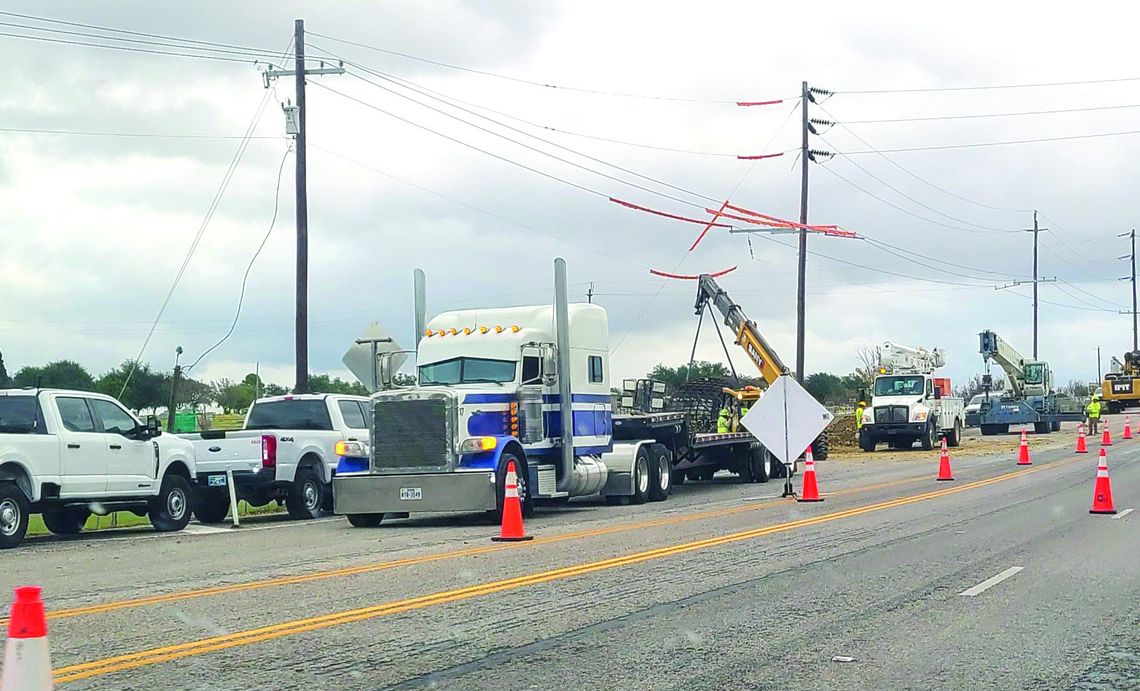
Throughout Taylor and the surrounding countryside, large steel utility poles are replacing the wooden t-shapes that have been an iconic part of the Texas landscape for generations.
Oncor spokeswoman Kerri Dunn said the project to rebuild the 100-yearold Taylor Switch-Holland 69 kilovolt transmission lines will better serve the city and the community.
The poles are around 100 feet tall, and where the transmission line makes a turn the poles are supported by concrete bases up to 9 feet wide and over 3 feet tall, such as the one in Fox’s yard.
They are part of the 144,000 miles of power lines Oncor and its subsidiaries operate, delivering electricity to more than 4.1 million homes and businesses.
“The original line was built in the 1920s and consisted of aging wood-pole structures and equipment that was nearing the end of its useful life. Our team has also responded to a recent increase in weather- and equipment-related outages for customers served by this line, which we believe will be alleviated with this rebuild,” Dunn said.
The poles being replaced hold transmission lines, which are used to carry high-voltage electricity from where it is generated to the substations, where it is then distributed along lower-voltage lines to homes and businesses.
Oncor is only replacing transmission lines in this project, not distribution lines, so the change from wood to metal poles will not be happening citywide.
LOOKING TO IMPROVE TRANSMISSION
Dunn said this transmission line feeds into the Taylor substation and affects Taylor residents’ electricity delivery. The upgrade will help improve service reliability and provide additional capacity potential at Taylor substation, according to the utility.
At this time, the voltage level will remain at 69 kV though the new lines can support twice that amount as the area’s need for more electric power grows with additional industries and population.
City leaders first heard about the upcoming project in May and tried to work with Oncor on altering a portion of the line route.
Ariola said they were surprised when they saw firsthand the scope of what was happening in October.
“We were informed simply that the maintenance that they were going to conduct, the work was simply maintenance of existing transmission lines with upgrades to poles. So we’re thinking wood to metal of some type, not really deep into the sizes,” the mayor said.
Ariola said Oncor’s first version of the line upgrade showed poles being installed in the Taylor City Cemetery, running through the historic African American burial section.
“So that was a non-starter. We issued a stop work (order) and requested a version (going) around the cemetery,” Ariola said. “It made sense to go around the outside, the outer rim. And in answer to our stop work, Oncor issued a stop work of their own of all Oncor activities in the city limits, (including) pole replacements, disconnections and meter installations.”
Dunn agreed that Oncor did cease work due to the stop-work order, but said it was due to the city requesting “an immediate stop to all Oncor work” in Taylor.
“Oncor honored the city’s request to support ongoing discussion regarding the project. Unfortunately, during this time, Oncor was unable to interconnect homes and businesses who were seeking electric service due to the stop-work order. Oncor continued coordinating with the city and resumed all project work when the stopwork order was rescinded,” Dunn said.
Oncor did reroute the transmission lines to skirt the easement along the front of the cemetery.
City spokesman Daniel Seguin said it was in Oncor’s interest to make that change because the state requires any construction at a cemetery to go through special cultural resources and archaeological investigation to ensure nothing is going over graves that may be unmarked or improperly identified.
NOTIFYING PROPERTY OWNERS; SOME STILL UNAWARE
Utility company officials said they determined locations for the poles on a site-by-site basis, aiming to install the steel poles at or near the location of the previous wooden poles.
Dunn said they did make some minor location changes after discussions with landowners and on-site observations.
Although the project did not require landowner notification – Oncor already owns the easements where it is building – the company sent multiple mailings during the planning and early construction phases to properties located along the line.
Still, many homeowners were unaware of the project’s size until it was underway.
“One day you’re enjoying a quiet neighborhood. The next they are installing the biggest utility pole you have ever seen in your front yard. Can’t stop it so I just laugh about it now. A little warning would have been nice,” Taylor resident Carla Hoffman posted on social media in October.
Hoffman said she was unable to leave her driveway due to the construction.
She asked one of the workers and was told they would be installing a high-power utility pole.
Unlike Fox, who has lived in her home for decades and plans on leaving it as an inheritance to her daughter, Hoffman is a first-time homeowner who purchased her house on Hosack Street in May.
A lifelong Taylor resident, Hoffman was proud to finally become a homeowner and in a letter to the city, she spoke of how much she loved the town, her neighborhood and her neighbors.
She said on Oct. 13 she awoke to the street being unexpectedly shut down, and neighbors she spoke with were equally confused since they had seen no notices.
“Huge steel metal power lines placed right in people’s front yards in a neighborhood. It’s hard to put into words how unsightly this is,” Hoffman wrote.
City representatives told her they were basically powerless to reroute the project, and since Oncor owns the easements, the utility was within its legal right to continue.
Fox also said she received no notice until two days before construction began.
“They just came to the door because of the tree. I gave them permission to take the tree down. I didn’t really think I had any choice,” she said.
MEETING WITH ONCOR
At the Texas Municipal League annual conference held in October in Fort Worth, Ariola and City Manager Brian LaBorde spoke with Oncor executives. Ariola showed the company representatives a photo of Fox’s home, with the large concrete pole base beside her driveway.
City officials expressed their view that what Oncor was doing was not right, and Oncor executives agreed to come to Taylor sometime soon and see the impact of their decisions in person.
“It’s within their legal right to do what they’re doing, but it devalues our citizens’ property. It would have cost them a whole lot more money to go around Taylor but that would have been the correct answer.
And when we tried to hold them to task, all of our work stopped. And our hands were tied,” Ariola said.
While the mayor acknowledges taking the shortest route is a business decision based on cost and return on investment, he added a process which takes the community into consideration would make for a better partnership.
Ariola said electric-company workers are not to blame for what is happening, noting “pole climbers” are the ones out working during severe weather to restore power and keep residents’ lights on.
TO SOME, MORE THAN UNSIGHTLY
While residents are apprehensive about their quality of life living with giant utility poles towering over the trees and landscaping, there are other concerns as well.
Fox worries about flooding, since the concrete base is built in the natural drainage path past her home. Others have raised concerns about unsightly trimming of trees near power lines, and some wonder about the effects of extremely-low frequency radiation and electromagnetic fields However, the World Health Organization reports there have been no definitive studies linking EMFs to illness.
In addition, the large utility poles can decrease the value of a home for resell, according to real estate industry experts.
“A 2018 study from the Journal of Real Estate Research found that vacant lots near high-voltage power lines sell for 44.9% less than equivalent lots that aren’t located near power lines,” according to an article by Orchard, a national real estate company. “If you take a step back, a lot that is located within 1,000 feet of transmission lines tends to sell for 17.9% less.”
Local real estate broker Pamela Pfiel said much of what a property sells for is determined by market factors. Homes like those on Hosack and Old Thorndale Road tend to attract firsttime homebuyers, blue-collar workers and older people looking to downsize.
Having a shortage of those types of homes in a city can drive up demand.
“There are pros and cons to the new metal poles. First and foremost, they are an eyesore that can hurt property values in the immediate vicinity, especially properties adjacent to the poles,” Pfeil said. “However, the tall metal poles reduce the quantity of wood poles and are well above the tree lines, so it eliminates power-outages from broken tree limbs.”
DAVID AND GOLIATH
Residents and city leaders said they feel powerless against the utility.
“When I first heard personally about the project, how it was going through the neighborhoods, I knew, Oncor, they’re doing those folks wrong,” Seguin said. “It’s not just the mayor being an advocate...you have an entire staff of 200 folks at the city of Taylor who are working in advocacy each and every day.”
Even if Oncor executives come to Taylor in December, as hoped, what the visit will accomplish is unclear.
“This is obviously a done deal now. There’s no going back from what they’ve started to install. If they come down to visit, I hope it shows them this is not OK in a small neighborhood and they reconsider next time and try their hardest to go around a neighborhood,” Hoffman said.
Dunn said the company recognizes the importance of engaging with local leaders and community members about significant projects such as transmission line rebuilds.
She said Oncor will continue to closely work with customers and local officials as the project proceeds.
Construction is expected to finish by the end of the year, weather permitting. Cleanup and restoration work will likely continue into spring 2026.
“Everybody’s upset. Never mind the fact that when you look out the front door all you’re going to see is this big post,” said Fox. “The value of this house has gone down to nothing, I’m sure. At this point I’m basically just being robbed.”
“It’s within their (Oncor Electric Delivery Co.) legal right to do what they’re doing, but it devalues our citizens’ property.”
— DWAYNE ARIOLA TAYLOR MAYOR

Comment
Comments