
How one company is innovating with hemp
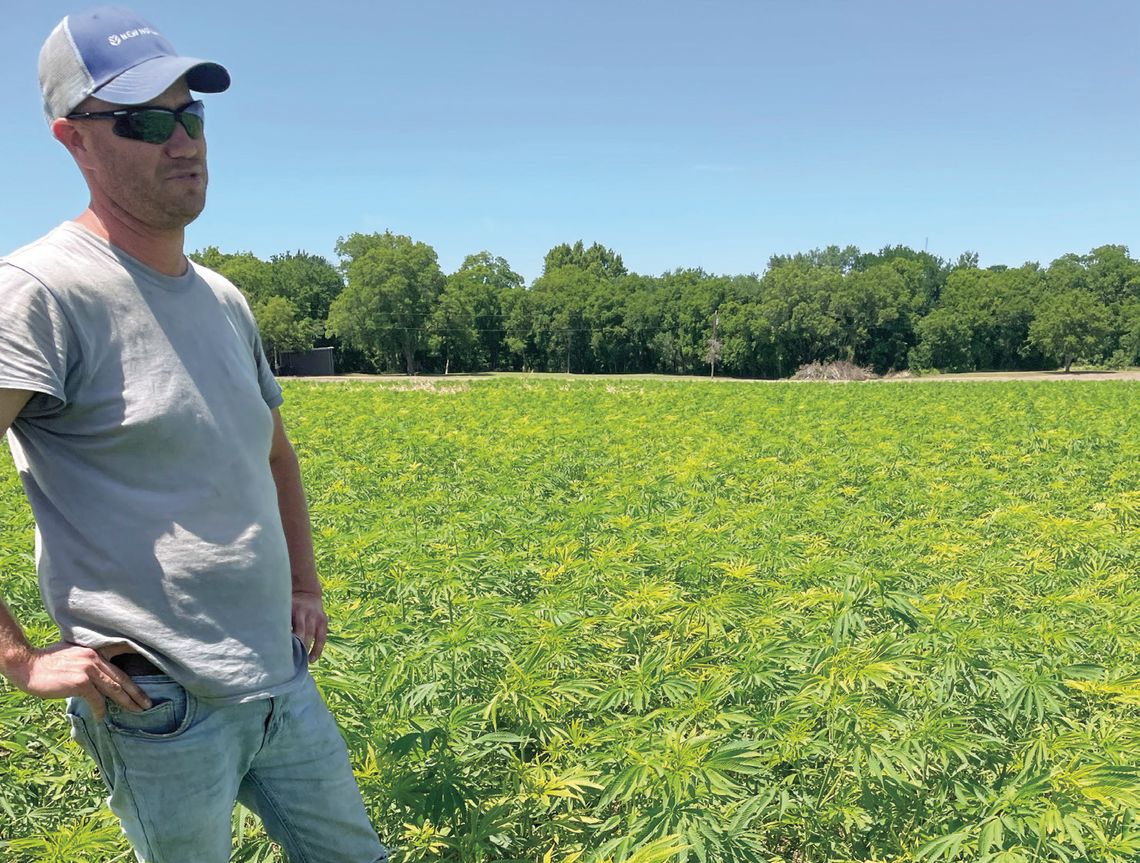
TAYLOR — Lucas Evans didn’t plan to be a farmer. But these days the 29-year-old Taylor native is proud to show off lush rows of tall green hemp plants on his farm outside of town.
This is the Blackland Prairie, the dark, rich soil that once drew cotton farmers whose production made Taylor the largest inland cotton market in the world. It’s the kind of soil where generations of Evans’ family before him owned thousands of acres near Hutto a century ago. By 2000, most of it had been sold.
The family didn’t abandon agriculture, though. A new business, E3 Agriculture, traces its roots to 1996, when Lucas was still a toddler. Today he’s taken that legacy in a very different direction.
Evans never lost his passion for the land. At Southwestern University, he majored in environmental studies, sharpening his interest in ecological science and economic sustainability. He graduated in 2018, the same year a federal farm bill decriminalized growing hemp. Intense research convinced him hemp could be the key to an agricultural revival in Texas – a localized, sustainable economy rooted in the soil he grew up on.
“We talk about innovation, but we have missed out on innovation in farming,” Lucas said.
The irony isn’t lost on Evans that while Samsung Austin Semiconductor’s chip plant is bringing billions in investment to Taylor, much of rural East Wilco still sits
“In a world that would seem too daunting for some, what he’s tackling – it’s exactly what you need in somebody driving this kind of mission.”
— JASON JONES hollowed out.
“Drive 45 minutes outside any city in Texas,” he said, “and you’ll find a town where the only things left are a Dollar General and two gas stations.”
He wants to change that – not by replacing tech, but by reclaiming agricultural industry.
“We love Samsung Semiconductor, we’re just a different kind of growth,” he said. “We call our plans for the cotton gin C.H.I.P. One – the Center for Hemp Initiatives Project.”
He added, “There’s a gin in every cotton town in Texas. These gins are the perfect footprint.”
His idea is to turn them into hubs for processing hemp – reviving not just buildings, but jobs, supply chains and small-town economies.
“We’re trying to build back agriculture in Taylor and places like it,” he said. “Hemp is the ideal candidate.”
TEXAS HEMP PROCESSORS
In 2019, Evans founded Texas Hemp Processors. In 2021, he created E3 Agriculture LLC as a parent company for projects that range from research and development into fiber genetics, to consulting with other farmers, to processing hemp for animal feed, building materials, textiles and more.
Since 2018, he said, E3 has processed and sold about a million pounds of hemp, primarily for animal feed and building products.
“From seed to shelter” is one of his mantras. He believes this is just the beginning of a multimillion-dollar operation.
One critical component of Evans’ success so far is his grounding in environmental science. Bluebonnet Bioscience, part of the E3 family, is focused on developing Texas-adapted hemp seed genetics and high-protein feed for ranchers. For several years Evans has worked with Texas A&M University researchers to refine varieties and genetic lines of hemp suited to Texas weather and soil – both of which vary widely depending on location.
“Our work with E3 is mostly in the Taylor area,” said Dr. David Baltensperger, head of Texas A&M’s Soil and Crop Sciences Department. “That’s the Blackland Prairie, a relatively narrow strip of soil along (Interstate 35) to the east of San Antonio all the way up to Dallas. It was Texas’ original cotton country. Hemp has a different quality of fiber that’s longer and stronger than cotton, more like bamboo, so it requires slightly different processing.”
Now that American farmers are growing industrial hemp again, Baltensperger said A&M engineers are working on 3-D printing of everything from building materials to aerospace parts using micronized hemp powder.
“Any time we grow something, we want to have a way to sell what we produce,” said Russ Jessup, director of A&M’s AgriLife Research and Extension Center. “Not many market channels have developed yet to process hemp. But there is a huge demand for lightweight, sturdy objects. … In aerospace, the automotive industry, construction, there’s huge opportunity being explored for industrializing hemp.”
REPURPOSING COTTON GINS
Evans is betting on those opportunities. He runs seed trials and research projects at his 40-acre farm, contracts with other growers in the region, and supplies hemp seed, fiber, hurd and resin for various uses. His vision is intensely local: processors near farmers, farmers near markets and all of it tied together by rural infrastructure that already exists.
Repurposing abandoned cotton gins is a key part of that plan.
This spring E3 purchased the shuttered Williamson County Gin, a 1940s-era mill that hasn’t processed a bale in years. The windows of the 15,000-square-foot metal structure are cracked, the walls and beams weathered. But while some see a relic of a vanishing farm economy, Evans sees the hub of a new one. He plans to turn the building into a hemp processing facility.
“The beauty of these gins is, there’s one in every town in Texas cotton country,” he said. “I’m currently talking to the owner of the Lockhart cotton gin, and there’s a lot of interest from other towns who have gins. We’ll keep our 40acre pilot plant and farm outside Taylor for (research and development), and the gin here in Taylor will house our scaled processing production.”
Evans sees the repurposed mill as a step forward in the quest to bring new life to struggling farms and depressed rural areas in East Wilco – new opportunities for nature-fueled growth. Taylor Iron-Machine Works, a century-old family business that originally built and repaired equipment for farmers, is right next door to E3’s Sturgis Street mill. Like Evans, CEO Curtis Hickman is a direct descendant of his company’s founder and was raised near Taylor, just outside Thorndale.
Their primary project is a decorticator, essentially a cotton gin for hemp.
“The decorticator takes the main stalk and breaks it down between the hurd, that pulpy core and the fiber on the outside,” Hickman said.
Their first machine, he added, likely will be about 15 feet long and 6 or 7 feet tall, built from scratch in the same metal building his family constructed decades ago. The goal is efficiency – producing clean fiber for textiles and hurd for building materials like hempcrete and board.
Hickman said he’s watched Evans grow the project piece by piece.
“I’ve known him about two years,” he said. “We’ve made some bricks out of the hurd. Now I think the focus is more on particle board.”
For Hickman and the team at Taylor Machine Works, returning to agricultural manufacturing feels like getting back to their roots, he said.
What happens after the hemp is separated?
Hemp seed becomes livestock feed – a business that “keeps the lights on right now,” he said. “We’re using all the seed. It’s very high protein and omega oils. Animals love it.”
The company works with mills to create balanced feed mixes, primarily for chicks and laying hens.
Fiber and hurd, meanwhile, become building materials. Evans is producing hemp chipboard, 4-by-8 hemp-wood panels and hempcrete blocks. The fiber he doesn’t use locally is sent to North Carolina for nonwoven textiles.
“The gin is about the infrastructure,” he said. “We’re really using the building – the electricity, the compressed air – for pressing panels and such.”
Jason Jones, another East Wilco native and founder of Liberty 3-D construction company, is also enthusiastic about E3. Evans is one of his suppliers for an innovative 14-home development in Rockdale that uses steel framing and 3-D-printed hemp-based board for insulation and wall systems.
“Lucas has been fantastic to work with,” Jones said. “We’re doing 14 homes. The idea is a nontraditional home that isn’t just concrete and carpet, something energy-efficient. Three of the structures are using material from Lucas’s farm.”
Jason Jones admires Evans’s determination.
“In a world that would seem too daunting for some, what he’s tackling – it’s exactly what you need in somebody driving this kind of mission,” he said.
East Wilco officials are watching closely.
The Taylor Economic Development Corp. has already pledged conditional grants to help E3 redevelop the Sturgis Street gin. There’s some buzz building about growth on the south side of town.
But Evans is clear-eyed about the hurdles. Banks are still shy about financing hemp processors.
“We can’t get a half-million-dollar loan,” he said. “We’re always in fundraising mode.”
Farmers are eager for a new crop – especially one that may pay $800 to $1,300 an acre – but many are hesitant to plant without more stable markets.
Still, he believes the risk is worth it. “Industry is looking for sustainable inputs,” he said. “Farmers want this. Communities need this.”
It’s optimistic. But then so is a field of hemp growing tall in the blackland soil where cotton once ruled. Evans is confident he is on the leading edge of a new American enterprise – one that is taking root in East Williamson County and places like it nationwide.
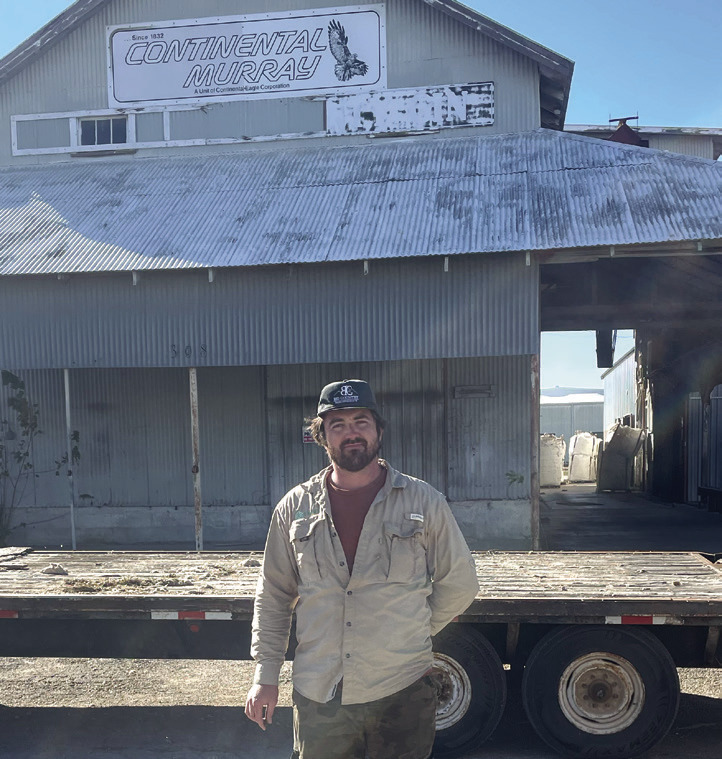
Lucas Evans wants to revitalize local gin mills — such as this one on Sturgis Street in Taylor — by processing hemp. COURTESY PHOTO

Comment
Comments