
GOING VERTICAL Coupland-based growers explore year-round aeroponic farming
ON THE COVER
Danielle and Will Vermillion are the owners and operators of Vermillion Farms, the only aeroponics farm in Williamson County. The Coupland- based endeavor features COUPLAND — Farming in Texas has always been a struggle pitting man against nature. From mercurial weather to pestilential assaults, farmers today can now also add the challenges of labor shortages and global-market fluctuations to their list of livelihood complications.

Photo by Emily Treadway
AGRIBUSINESS
ROOTOF THE MATTER A look into aeroponics farming
Land is a separate concern. Texas has seen the price of land increase at a mind-blowing, exponential rate in the last six years, but rising costs are not the only worry as children of farming families leave to seek other careers and properties become industrial operations or are swallowed by urban sprawl.
What is to be done? How can these issues be mitigated while also growing fresh, healthy food?
Will and Danielle Vermillion of Coupland might just have an answer.
They own and operate Vermillion Farms, the only aeroponics farm in Williamson County.
‘TOWERFARMING’
Aeroponics is the process of growing produce without soil, but Will Vermillion added aeroponics is really about giving plants the oxygen they need.
“We all know that plants want our (carbon dioxide), but what most people don’t know is that a plant’s roots really want a lot of oxygen. They usually get that from water, but with plants in the ground or in a hydroponic system, the oxygen doesn’t always reach down to the roots,” Vermillion said.
There are different versions of the aeroponics technique, but they all involve plants’ roots exposed and not buried in dirt.
Vermillion Farms plants its crops in 12foot vertical towers. Many call aeroponics “tower farming,” but other aeroponics systems use flat boxes set on tables, stacked on top of other tables with grow lights hanging between them.
Vermillion’s interest in aeroponic farming stemmed from a documentary he saw about the subject that utilized the stacked tables and grow lights method.
“One-hundred percent of the photosynthesis was artificial, which is not necessarily a bad thing, but there is a lot more cost involved. With the towers, I use all-natural sunlight,” Vermillion said.
The Vermillions have a 4,300-squarefoot greenhouse constructed from diffused polycarbonate panels.
“They shatter the light so it’s more evenly distributed, which is very important when you’re growing in towers…The panels also block 99% of the (ultraviolet rays) and 100% of the infrared so that no surface is getting radiated from the infrared rays and I don’t get sunburned from the UV,” Will Vermillion said.
Inside the Vermillion Farms greenhouse there are 200 towers that each take up 12 square feet with 52 plants per tower.
“When you compare that to field-grown, they might be able to grow nine plants in that same amount of space,” Vermillion said.
Vermillion Farms produces one acre’s worth of crops from one-tenth of an acre.
The towers are positioned inside the greenhouse to allow the plants to receive light evenly from the top to the bottom. The roots are suspended in mid-air inside the towers, receiving nutrients through enriched mist.
“That way most of (the plant’s) life is in the air which allows better mineral absorption,” Vermillion said.
Through the misting system, aeroponics farms use 95% less water than crops planted in the ground.
CROPS
Vermillion Farms grows romaine, butter leaf and arugula lettuces, spinach, tomatoes, cucumbers and seven different herbs including chives and cilantro.
Before the seedlings at Vermillion Farms are placed in the towers, they are planted under grow lights in rockwool, which is a natural product created primarily from crushed basalt rock that is spun into a fiber in a process similar to that of cotton candy. The fiber is then pressed into a spongelike sheet with holes bored into it for the seedlings.
Vermillion said rockwool works so well in the aeroponics towers because it is light, not super dense and it absorbs the perfect combination of air and moisture.
“The defining factor of what makes aeroponics so great is that you’re creating this hyperoxidated environment for the roots so that it’s able to absorb the oxygen it needs through the root base and grow and be the best possible plant,” Vermillion said.
Even when harvested, the Vermillions leave the roots on their plants.
“The moment you take (the roots) off, the plants start to decompose, which means it’s losing nutrients,” Will Vermillion said. “Our produce is the most nutritionally dense you can find compared to anything in the grocery store, if for no other reason than (the plant) is still living.”
He has also noticed the roots of many of his herbs have the same distinct aroma as the plant itself.
“Some people are starting to say to use the roots too,” Vermillion said, noting he has seen recipes calling for not just cilantro but cilantro root.
RAPIDGROWTH
Most Vermillion Farms crops grow so quickly, the family receives a greater return on their investment.
“On average, depending on the plant, you can see 20-40% faster growth in aeroponics crops than crops planted in the ground,” Vermillion said.
Plants can grow in the winter, too, though with less daylight many take eight to nine weeks to sprout as opposed to six weeks in the summer.
“And we don’t have to stop for seasons,” Vermillion said. “We grow 52 weeks a year.”
The weather outside the greenhouse doesn’t affect production inside. In the heat of Texas summers, the temperature in the greenhouse never climbs above 85 degrees.
“A lot of it depends on the humidity, but we’ve got the evaporative cooler that does most of the work,” Vermillion said.
The evaporative cooler, also known as a “swamp cooler,” is 5 feet high and 30 feet long. It keeps the greenhouse temperature 10 to 25 degrees cooler than the outside.
In the winter, temperatures in the greenhouse don’t drop below 60 degrees. Propane heaters at both ends of the greenhouse provide the warmth with fans on the floor circulating the warm air. Sail cloth is also stretched above the towers on cold nights, trapping the warm air down below with the plants.
In the event of a power outage, the Vermillions also have generators to keep the electricity going.
MOREBENEFITS
Another benefit to growing crops indoors is that it generally prevents the pesky problems caused by insects and other pests, although the Vermillions have noted they occasionally get spider mites on their tomatoes and aphids on the cucumbers.
A regular release of live ladybugs received through the mail tackles their aphid problem as aphids are a favorite snack of ladybugs. The Vermillions also discovered another natural and very simple deterrent to the spider mites: water. They spray the mites with a hose and the problem is solved.
The Vermillions maintain an all-natural, organic approach to their farming but do not have organic certification.
The U.S. Department of Agriculture has given aeroponics- and hydroponicsgrown crops an organic designation, despite disagreement from the National Organics Standard Board that has argued organic farming comes from healthy soil fertility and biodiversity. The USDA countered the Organics Food Production Act doesn’t explicitly prohibit soil-less growth systems.
Sidestepping the issue, the Vermillions have labeled their produce “beyond organic.”
EXPERIMENTALFARM
There are no aeroponic towers at the Stiles Farm Foundation in nearby Thrall, but farm manager Ryan Collett said he is interested in the process.
Stiles Farm is an experimental farm operated by the Texas A&M AgriLife Extension Service. Not only does the farm raise different crops or try different farming practices, but they test agricultural technology, such as the John Deere autonomous tractor — which originates at a facility just south of Coupland — and using drones for treating and analyzing crops.
Collett and Vermillion both consider aeroponics farming a type of agricultural technology.
Collett would like to try aeroponics farming, but “it would pull me away from the other aspects of our business model,” he said.
Collett also noted if someone wanted to get into tower farms they should focus all their time and attention on that process — which is exactly what the Vermillions have done.
Vermillion Farms is a family-run business and the Vermillions have embraced the life of farmers, “seven days a week, day in and day out,” Will Vermillion said.
While the aeroponics farm was Vermillion’s idea, he has had his wife’s wholehearted support, even when she was working at farmers markets with their third child strapped to her chest.
“I knew from the beginning that I was going to be involved…I love this,” Danielle Vermillion said.
In the early stages of the farm, the Vermillions enlisted family members to help sell produce at 13 different farmers markets in the surrounding area.
“But now we’re down to three,” Will Vermillion said.
On Saturdays, the Vermillions can be found at the Wolf Ranch Farmers Market in Georgetown and Barton Creek Farmers Market in Austin. Sundays, Vermillion Farms sets up shop at the Texas Farmers Market at Mueller in Austin.
The Vermillions have plans for expansion. They would like to build more greenhouses and increase their crop production. Eventually, Vermillion Farms would like to deliver boxes of fresh food directly to customers’ doorsteps.
“When I first learned about (aeroponics farming), I said, ‘This is how we do this. This is how we feed people’… Economically, environmentally and nutritionally, it hits every nail on the head,” Will Vermillion said.
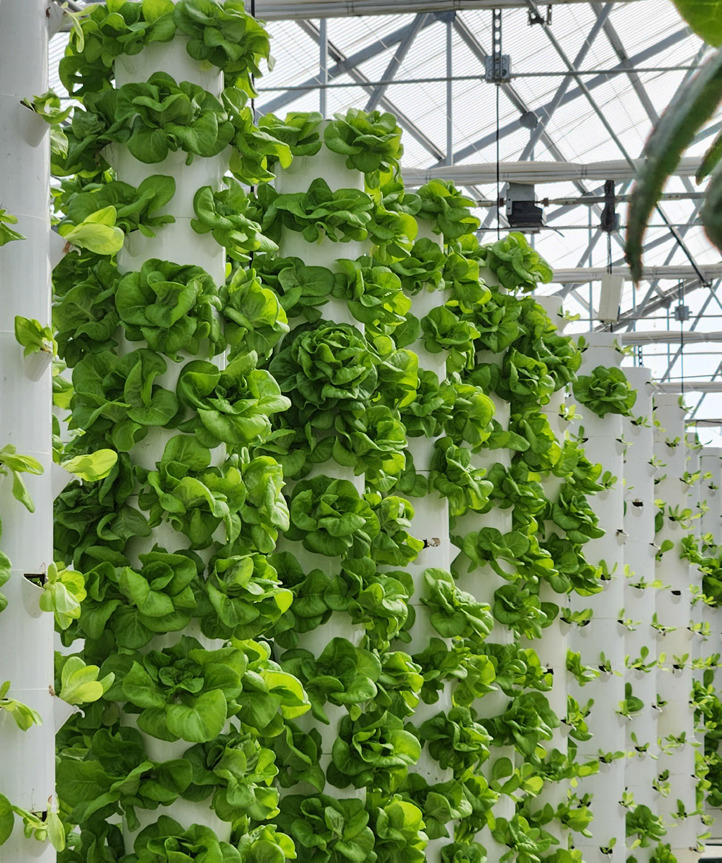
The butter leaf lettuce is almost ready for harvest. PHOTO BY EMILY TREADWAY

Comment
Comments