
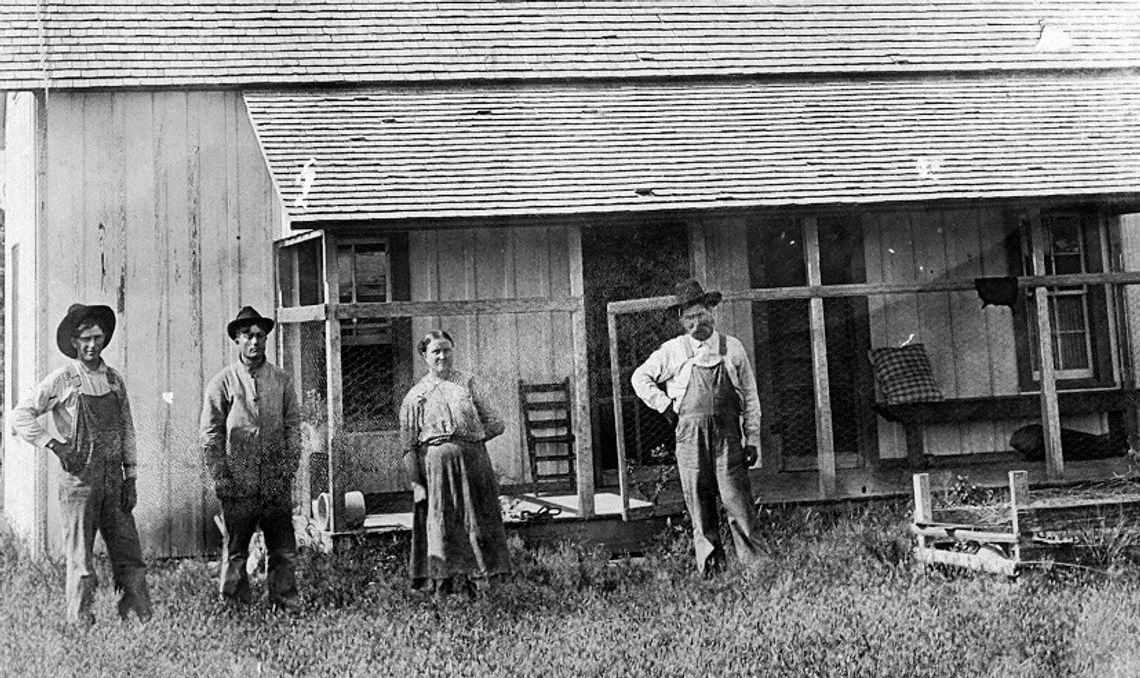
OLD WORLD ROOTS LIVE ON The impact of Czechs and Swedes still resonates across East Wilco
This year, as the cities of Hutto and Taylor celebrate their 150th anniversaries, many credit the arrival of the railroad as the catalyst for the economic boom that enriched eastern Williamson County during the late 19th century.
However, the Czechs and the Swedes — two immigrant groups known for their industriousness, farming skills and unique cultural traditions — also fueled the growth of the region during that era.
“Taylor was founded in 1876 when the railroad was built, and 30 years later, it was the biggest town in the county,” said Jon Stephenson, a member of the Williamson County Historical Commission. “That was driven mostly by immigrant populations.”
THESWEDES
According to the commission, the earliest wave of Swedish immigrants came to Texas in the mid 19th century at the behest of Swante Magnus Swenson, the first modern-era Swedish settler who arrived in America in 1836.
After becoming a successful self-made plantation owner and businessman, in 1847 Swenson returned to Sweden to recruit families to work on his farms for a year in exchange for free passage to Texas, alongside his uncle and business partner, Swante Palm, county officials said.
“It turned into this pipeline of Swedes from the same area of Sweden coming to Texas,” Stephenson said.
Many of these newcomers settled between Round Rock, Hutto and Taylor.
“They were hardworking farmers, and they were hospitable neighbors,” Stephenson said. “They fit right in with the other Anglo settlers in the county, but they also were a close-knit group who looked out for each other.”
Georgetown resident Larry Olson said his grandparents, Anna and Anton Olson, who owned a 184-acre farm near Taylor, would often recount the hardships their families had endured prior to immigrating to the United States in the early 1900s.
“Sweden was agrarian, and a third of the population left from 1880 to 1920,” said Olson, whose Anna+Anton Olson Legacy Foundation currently funds local nonprofits in honor of his late grandparents. “Grandpa would tell me that they had to make soup out of birch bark sometimes. They hadn’t industrialized, so the population had gotten really big but the opportunities weren’t there and there was a shortage of food.”
By the 1880s, Swedes had become the largest immigrant group in Williamson County, settling around Georgetown, Palm Valley, Hutto, Taylor, New Sweden and beyond.
“If you look at the census, the 1880, 1900 and 1910 census, the Swedes are the most dominant group of immigrants born in a foreign land,” Stephenson said.
These Swedes not only farmed, but also became “businessmen, service people, you can go down the list,” Stephenson said. “Some were tailors, watchmakers and jewelers. They just fit right into this growing county. ”
Former Taylor Mayor Brandt Rydell, who is half-Swedish, remembers hearing the Scandinavian language spoken at the Hutto Lutheran Church, previously known as Hutto Swedish Evangelical Lutheran Church, during his youth.
“Growing up in the 1970s, there were certain times of the year with certain services where a hymn would be sung in Swedish, and there were enough Swedish speakers in the congregation from the older generation that the church would be filled with the sound of a Swedish hymn,” Rydell recalled.
These days, Hutto Lutheran is a thriving congregation that continues to recognize its Swedish roots despite changing demographics, he added.
“I am just amazed at the vitality, but there is barely a hint at the Swedish heritage of it,” he said. “My family is about what is left, but they still honor the origins and the traditions.”
One way is by celebrating Saint Lucia, a Swedish holiday observed on Dec. 13.
“It is a winter tradition, with a candlelight procession, and they serve these saffron buns,” Rydell said. “The kids pass it out. The girls are dressed in white, with one with candles in her hair, and the others are like the attendants. And the boys are called star boys with (conical) caps… One aspect of Santa Lucia is the children in the family are supposed to serve their parents breakfast in bed.”
Rydell said he loved his grandmother’s homemade rye bread and other baked items. However, one tradition he avoided was her “lutefisk,” a dried white cod fish soaked in lye and buried in ash.
“It becomes this gelatinous texture,” he said with a laugh. “It’s a very involved process and not delicious, but it’s a reminder of how hard folks had it.”
Olson also has memories of his grandma’s limpa rye bread and buttery cookies.
“When we were up there we would always go on Saturday nights to see her sister Ellen at her farm in Hare,” Olson said. “They were Swansons, and we were Olsons, and so both the sisters made these Swedish spritz cookies, a kind of a white cookie, that they would put in these funnels and push them out and make shapes. They would make those cookies in the shapes of S’s and O’s.”
THECZECHS
According to the historians, Czech immigration to Williamson County began in the 1880s, primarily from the historical Czech lands of Moravia and Bohemia, which are now currently part of Czechia, or the Czech Republic.
Though Czechs originally settled in the San Antonio area earlier in the 1800s, these newcomers were drawn to Taylor, Granger and Corn Hill because of the “abundance of good, relatively inexpensive farmland and the rich, blackland prairie soil,” Stephenson said.
Many of these new Williamson County residents were fleeing poverty and political instability in their homeland, he added.
“There was just this political turmoil over there,” Stephenson said. “People in Europe craved land. Land was very hard to come by.”
The Czechs had large, close-knit family units centered around farm life and a strong Christian faith, officials said.
Taylor businessman Tim Mikeska, the CEO of Mikeska’s Bar-B-Q Inc. and the owner of Mikeska Brands USA, echoed this assertion.
“In the 1880s and 1890s in Moravia, it was a difficult time, and everybody was poor,” said Mikeska, whose greatgrandfathers emigrated to the area in the 1890s. “People like my family were sharecroppers because they didn’t own any property.”
However, Texas offered a different way of life — and new opportunities.
Many of these immigrants became landowners, business founders and important members of the community through participation in churches, schools and social clubs, Mikeska said.
Prominent area churches with deep Czech roots today include Saint Cyril and Saint Methodius Church in Granger, as well as St. Mary of the Assumption Catholic Church and Taylor Brethren Church in Taylor.
Czechs also formed meat clubs, through which they used their butchering and traditional sausage-making skills honed in the Old World.
“Back then, there was no refrigeration so when you processed an animal you had to do something with it quick,” Mikeska said. “My great-grandfather would go out in the community and butcher other people’s animals: cattle, hogs, goats, sheep, ducks, geese, everything. They were butchers and they were very skilled at what they did.”
Over time, this turned into a popular family barbecue business that was even featured in Texas Monthly magazine.
“My grandfather John taught all six of his sons how to butcher animals by taking them to the beef club in Taylor,” he added. “This evolved into butcher shops and markets, and that evolved into barbecue and catering, and that has evolved into wholesale food distribution in 26 states.”
These days, the Mikeska brand just began offering a sausage wrapped in a pastry from a generations-old family recipe, which Mikeska emphasizes isn’t a “kolache.”
Despite what some marketing campaigns might have you believe, the kolach is a Czech pastry stuffed with sweet fillings, not meat.
“Let’s get this straight,” Mikeska said with a laugh. “Kolach is one, and kolache is plural for more than one. You can call it a pig in a blanket or you can call it a sausage kolache, but we find that very offensive. That would be like if you called a tortilla a frisbee. The thing that we put meat into in a pastry is called a klobasnek.”
Though the Czech influence has faded somewhat, Granger still had its own Czech-language newspaper called The Našinec, which means “fellow countrymen,” printed until 2018, said Monica Stojaník, the town’s former mayor.
In addition, the local radio station in Taylor played Czech music on Sunday afternoons and daily until the early 2000s, she added.
Still, the Czech folk-music tradition continues in the area through the Taylor Czech Chorus, which often performs lively songs at Heritage Square Park and many other area venues, said Stojaník, who speaks, reads and writes Czech and serves as the nonprofit organization’s spokeswoman.
“We do polkas and waltzes, and we also do some spiritual music called polka Masses,” Stojaník said.
In addition, Stojaník can often be found wearing a kroj, which is a traditional folk costume featuring lace and ribbons, while sharing the Czech flag and other items at various area elementary schools, family reunions and more.
“I’m going to be honest,” Stojaník said. “I am so proud of my Czech heritage.”
SEEDS FOR THE FUTURE
These days, visitors to eastern Williamson County are more likely to hear Korean spoken than any other language besides English or Spanish, thanks to the recent arrival of Samsung Austin Semiconductor to Taylor.
Nevertheless, the cultural impact of the Czechs and the Swedes can still be felt to this day, the descendants of the pioneers said.
“It’s amazing,” Mikeska said. “My family risked everything to get on a ship and spend six to eight weeks at sea to come to a country where they could not speak the language, but they saw the opportunity and they saw the freedom.”
He added, “The dreams of my father and our grandfathers built the foundation, and today the Mikeska name stands as proof that faith, hard work and opportunity in this country can turn humble beginnings in a small village in Moravia into a legacy that serves thousands of people and hundreds of restaurants across America.”
For his part, Olson said his Swedish grandparents instilled in him a love of his heritage, an entrepreneurial spirit and a desire to help area nonprofits grow stronger.
Since Anna+Anton was founded in 2021, nearly $1 million in grants have been given to local charities, including the Boys and Girls Club of East Williamson County and The Greater Taylor Foundation to fund their recent communitywide needs assessment.
Olson said that as eastern Williamson County continues to grow, he wants to make sure no one gets left behind.
But he also wants the Olson name to live on.
“I’m kind of the last of the clan, and I have been looking at ways to recognize their names,” Olson said of his immigrant grandparents. “When I am no longer here, I didn’t want their names to disappear. They were just too important to me.”
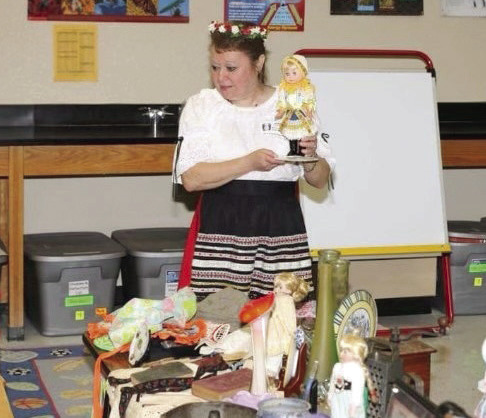
Monica Stojaník, the spokeswoman of the Taylor Czech Chorus, wears a traditional Czech kroj. COURTESY OF MONICA STOJANÍK
Comment
Comments