
As Taylor embraces the future, many say race relations still vital
TAYLOR — While the city’s star is rising as a technology hub attracting diverse talent from across the globe, many in Taylor — including some Black residents — still say they live in a divided community.
Others, however, note that in the year Taylor is celebrating its sesquicentennial, much progress has been made to close that gap.
“A lot of people are starting to open their eyes to the Black and brown community now. It’s better than my momma and daddy’s generation, but we have a long way to go,” said Pamela Griffin, a generational Taylor native who lives in the historically Black South Side of town.
She has been leading a fight against the development of the Blueprint Data Centers in the field behind her property.
“I’m working on the relationship between the south side and the city. The city has to realize there’s another community. They can’t just come and stick industrial stuff in our neighborhood,” Griffin said.
Brandt Rydell, another longtime Taylor resident and mayor from 2017-24, said the city has made progress but acknowledged there is a need to continue building trust.
Rydell, whose ancestors included Swedish immigrants to the area, served on the City Council for 12 years and alongside the city’s only two Black council members and a Black city manager, Isaac Turner, who served August 2014 to Jan. 25, 2019.
Taylor also has had an African American mayor, Don Hill. The former mayor’s wife, Leslie Hill, is a well-known and respected community leader.
“Representation matters, but what matters most is whether people feel heard, respected and included,” Rydell said.
A City Hall spokesperson declined to
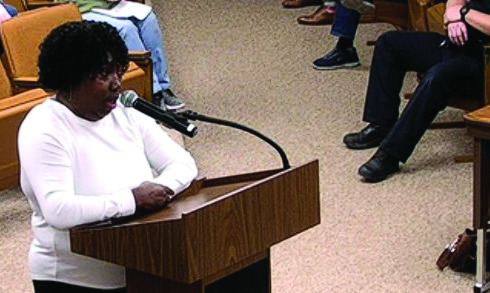
“I’m just going to keep working for my community.”
— PAMELA GRIFFIN,
TAYLOR SOUTH SIDE RESIDENT comment on this story but did offer this message: “The city rejects generalized claims regarding racial tension. We remain focused on serving the entire community with equity and professionalism.”
MAKINGSOMEPROGRESS
Robert Garcia, who served on the council from 2016-25, said while Taylor has experienced segregation and inequality, the city has made meaningful efforts to acknowledge its past and promote greater understanding and inclusion.
“Today, race relations in Taylor continue to improve through civic engagement, public dialogue and a shared dedication to community well-being,” Garcia said.
He pointed to the city’s communityoriented policing policy as helping build an atmosphere of trust, adding that race relations continue to improve through public dialogue and a shared dedication to community well-being.
“During this period of heightened political tension at the national, state and local levels, remnants of Taylor’s historical racial prejudice at times resurface within the community,” Garcia said. “However, through the active engagement of civic organizations and the willingness of residents to acknowledge, confront and address these challenges, Taylor continues to move in a positive direction.”
Some cite as progress the fact the city’s newly appointed police chief, Joseph Chacon, formerly the head of the Austin Police Department, is Hispanic.
Meanwhile, most residents acknowledge Taylor has a history of strong Black community leaders and activism. Former Councilman Gerald Anderson’s great-great uncle was Bill Pickett, a legendary Taylor rodeo cowboy who invented “bulldogging,” a sport that later was renamed steer wrestling.
Pickett traveled the world with the 101 Ranch Wild West show in the late 1800s, even performing for royalty in the United Kingdom. A road in Taylor is named for him, and Anderson founded the Bill Pickett Educational Foundation in his honor, a charitable organization focusing on youth.
Williamson County’s first medical clinic for Black people was in Taylor, started by Dr. James Lee Dickey.
Dickey established a modern, 15-bed hospital and set up a prenatal clinic. Dickey and his wife, Magnolia P. Dickey, helped secure a new school and recreational facilities, a federal housing project and more resources for the African American community in Taylor.
The original Taylor home of the Dickeys was destroyed by arson in July 2022. Many in the Black community suspect the act was racially motivated. Efforts are underway to rebuild the historic site.
It is not the only site revered by the African American community struck by a recent fire.
Another blaze in June destroyed the old Dickey-Givens Community Center at 903 E. Martin Luther King Jr. Blvd., which for years served as an important gathering place for African American residents.
While the cause appears to be “human activity,” it was not ruled arson, according to the city.
The old center in 2016 was named for Magnolia P. Dickey and renowned local educator Lessie Givens. A newer hall exists at 1015 E. MLK Jr. Blvd.
James L. Dickey is one of four African Americans in Taylor’s history to be named Citizen of the Year, alongside community volunteer Leslie Hill, her husband Don and Taylor Independent School District trustee Shorty Mitchell.
Taylor was also the hometown of Dan Moody, an Anglo who was the first district attorney in Texas to win a significant case against the Ku Klux Klan and is said to have broken the KKK’s advancing racist hold on the state.
Moody went on to become the youngest governor in Texas history. The Moody Museum at 114 W. Ninth St. has more information about Moody, Pickett, Dickey and other famous Taylor residents of various ethnic backgrounds.
Area leaders said with Samsung Austin Semiconductor’s fabrication facility on Taylor’s Southwest Side becoming operational this year, it is important to continue recognizing diversity with an expected influx of South Korean workers and potential neighbors.
MOREWORKISNEEDED
In February, Griffin helped city leaders set up a meeting to talk to South Side community members.
She encouraged City Manager Brian LaBorde and Interim Assistant City Manager Tyler Bybee to take the first steps to come hear what her neighbors had to say, but cautions that trust will build slowly.
“The power is always going to be there. People want to control others, that’s part of life. Black and brown people don’t trust that easy because they’ve been disappointed too many years,” Griffin said. “I’m not going to allow a power trip to control me. I’m just going to keep working for my community.”
Some wounds take a long time to heal. Rydell said one of his most meaningful moments as mayor was speaking at a memorial for Caldwell Washington Sr., a 23-year-old Black man lynched in Taylor in 1933 and offering an apology on behalf of the community.
“Visiting the National Memorial for Peace and Justice in Montgomery (Alabama) and seeing his name among more than 4,400 victims underscored that this history is not abstract or distant. It is real, and it is personal,” Rydell said.
Part of the Legacy Sites, the memorial honors Black victims of lynchings in America.
“After the memorial, several residents told me they were surprised and proud that a Taylor mayor would address that chapter of our past,” Rydell said. “That surprised me. Acknowledging painful truths felt like basic civic responsibility.”
Stories like that of Washington may seem distant, but they are fresh in the minds of many Black community members.
Griffin recalls the neighborhood where she lives was outside of the city limits when her parents lived there, and they were discouraged from crossing into Taylor to shop for groceries or services.
Washington’s story hits especially hard for Anderson, who served on the council from 2019 to 2025. In 2023, Anderson said he was targeted by a racially motivated complaint around the time the council approved a pay raise for members on the dais.
The false complaint, Anderson said, alleged he verbally threatened an Anglo woman and others behind a petition movement.
The Taylor Police Department opened a case and then closed it as being unfounded, but Anderson still has questions.
“It’s not right,” said Anderson, who indicated if the episode had occurred a few decades earlier, the outcome might have been more dire for him.
TURNAROUNDTAYLOR
Even three decades later, a debate still simmers over whether an urban revitalization campaign focused on Black properties on Taylor’s South Side helped curb crime or acted as a catalyst to erase part of a culture.
Today, only foundations and empty lots hint at a once-thriving entertainment district known as “The Line.” Numerous buildings were bulldozed in 1994 to combat crime and drugs as part of a campaign called Turn Around Taylor.

“What matters most is whether people feel heard, respected and included.” — BRANDT RYDELL, FORMER TAYLOR MAYOR
The Line also had a symbolic meaning, as it segregated the racial divide in Taylor.
Many have praised Turn Around Taylor as an initiative to save the town, but others say it was a misguided effort that erased a culturally unique neighborhood that has yet to recover.
As reported in a December 2022 East Wilco Insider story, by the early 1990s, the Williamson County district attorney declared the area south of the railroad tracks an “open-air drug market” and a locale plagued by prostitution and rampant crime.
According to law enforcement accounts, drug-related arrests in Taylor reached an all-time high in 1993.
Turn Around Taylor reached its peak in 1994 and was aided by local law enforcement and the Texas National Guard.
By the time the dust settled, nearly 100 structures had been bulldozed by the engineering unit of the Guard. Some buildings were deemed in disrepair and condemned, while others were singled out as part of the narcotics trade.
A 1995 Texas House resolution recognized Turn Around Taylor, the Police Department, the Taylor Housing Authority and the city, declaring that “Turn Around Taylor has dropped overall crime 56% and violent crime 82% in targeted areas and a new spirit has taken hold so the neighborhoods are no longer controlled and victimized by dealers; the neighborhoods have changed from fearful victims to fearless victors.”
The legacy of the campaign culminated in a parade stretching from downtown to the blocks of newly vacant lots along The Line and featured then-Gov. George W. Bush, the future president.
Former Mayor Hill told EWI in 2022 buildings were being condemned for things that could easily have been fixed or given a new life with some redevelopment.
“Turn Around Taylor destroyed ‘The Line.’ It looked like there’s so much unfairness, and there’s still some now,” Hill said at the time.
Earlier works by Jason Hennington, Nicole Lessin and Travis E. Poling contributed to this story.
Comment
Comments