
COMPETITION
Coupland competitors play worldwide
COUPLAND – It came to the United States from Australia in the 1970s and has been played in Central Texas since the 1980s, but odds are most locals have never heard of polocrosse.
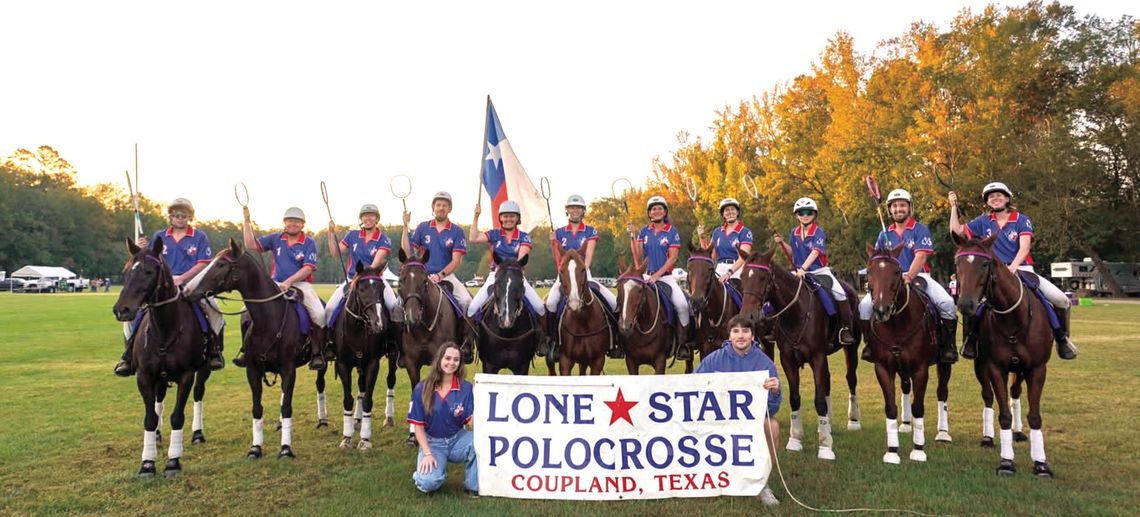
Similar to lacrosse but played on horseback, polocrosse is a sport that can be enjoyed at any age and any skill level. The Lone Star Polocrosse Club near Coupland is one of only two clubs in Texas registered with the American Polocrosse Association.
The other is in Alamo, Texas. Prissy Rummel comes from a long family line of polocrosse players. She is a past president with the Lone Star club and is still active with the group. Her sister’s family, the Poldracks, own the land where the club’s playing field sits at 6101 FM 1466.
Her children grew up in the sport as did many of her extended family members.
Rummel retired from competition in 2010 after winning her fight against breast cancer. Achieving success is something she’s used to. She rode for many U.S. national teams, claiming international victories at least 10 times.
Her sport has taken her around the world competing and giving clinics as far away as Australia, South Africa and Uruguay.
“Years ago, Texas had a bigger playing population than it does now. There were clubs in Plano and the Magnolia area, Conroe area,” she said. “There used to be clubs in Johnson City and Hunt. There are still a few players in those areas, but they don’t have full teams. But they’ll come down here and play.”
WORLDWIDE ATTRACTION
Polocrosse has over 6,000 registered players worldwide, compared to almost 24,000 competing in polo. Both sports are played on horseback, and that’s about where the similarities end.
Polocrosse is known as an easy sport for a rider to get involved with. Each participant only needs one horse. Rather than a hard ball and mallet, riders use a sponge-rubber ball and racquets that look like lacrosse sticks with a small net on a long pole.
Goals are made when the ball is thrown through opponents’ goalposts.
Players from across the region brought their trailers and horses to the Coupland playing field or “pitch” April 4-5 for the club’s annual tournament, the Jon Weber Classic. The established competition was renamed in 2000 to honor Weber, a Lone Star club player and coach who died of a heart attack during a polocrosse game in Hunt.
The Jon Weber Classic helps raise funds for local players selected for national teams traveling around the world. The worldwide polocrosse community has exchange programs that help riders find housing with local players when they travel to other countries. The hosting countries also provide mounts for the riders, since competitors travel without their horses.

I have met the best people through this
sport.”
— AUBREY SHUTTLES RIDER Aubrey Shuttles of Thrall has been playing since she was big enough to sit on a horse. The 20-year-old is considered by some to be among the best female players in the sport. She graduated in May from Texas State University with a degree in geography and environmental studies and is weaving in job hunting with travel for polocrosse competitions.
Shuttles competed in an international under-21 tournament against the United Kingdom in May, held in Pinehurst, North Carolina. The U.S. team prevailed, winning two out of three matches in the series.
The U.K. team named Shuttles as the U.S. Best Lady Player for the series.
In July, Shuttles and her brother Haydon will be heading to Ireland to compete as part of the under-21 U.S. versus Ireland tournament. The players will fly in and practice on their borrowed mounts, then do some sightseeing and socializing with the Irish players before they face off for three matches over July 10-12.
“I have been lucky enough to travel and get to experience the world through playing this sport,” Aubrey Shuttles said. “After I graduated high school, I took a gap year and was able to fly to New Zealand and play there for two months and stay with a family friend. Then to Australia and I spent five months playing there. I have met the best people through this sport.”
Her parents, Rob and Heather Shuttles, also met playing polocrosse, she said.
Her father played for a New Mexico team and her mother played for Lone Star. The two met up for friendly competitions, which soon became more than just friendly. Her parents raised her and her brother to play, and the family frequently competes together in local matches.
Aubrey Shuttles hopes she will be chosen for tournaments being played in Zambia, Aug. 14-16 and in Zimbabwe, Aug. 21-23.
TEAMWORK
To be selected for a tournament, players who can travel on the selected dates put their names on a list for consideration. The team coach and other coaches then observe the players during matches and decide which players will represent the U.S.
There are generally six people on a team. The game is played in a series of innings called “chukkas.” There are six chukkas lasting six to eight minutes each, depending on the tournament directors, with two minutes in-between. The teammates alternate, with three playing one chukka and the other three in the next chukka.
The events where one nation competes against another are called World Cup Test Matches. The International Polocrosse Council holds a World Cup competition every four years.
The next one is in 2028. The eight countries that are full members of the IPC participate in the World Cup: Australia, Ireland, New Zealand, South Africa, U.K., U.S., Zambia and Zimbabwe. There are at least 18 countries where the sport is played, including Norway, Uruguay, Chile and Canada, and those countries hold their own tournaments.
GETTING THE HORSES IN TUNE
The tournaments aren’t just for the hardcore players. The sport has an A through E system, where A signifies the highest level of play. Frequently matches are held for competitors playing at a lower ranking as well.
The A-E ranking system allows players to get to know the game and rise up through the levels at their own pace. It also allows the horses to learn what is expected. Players talk about getting “attitude” from their horse if they miss a catch, and other quirks that tell them the horse has its own ideas about how the game should be played.
“The horses love it, a bunch of them really get it. They learn how to play and know what they’re doing, and have strategies and stuff,” Shuttles said. “They know their jobs and the really good ones have their own opinions about what you should be doing.”
Shuttles added she and her horse have had to learn to work as a team, but they still sometimes disagree on when she should make a move.
Melissa O’Reilly, a veterinarian who frequently acts as the animal welfare officer at polocrosse matches, has experienced horses becoming mentally involved in the sport. Her husband, Patrick, bought a mare named Iba to train in polocrosse. The mare was being sold because the previous owner wanted to use her in barrel racing but the horse just “didn’t seem interested.”
Patrick took the horse for her first polocrosse training practice at the Lone Star club, and said that even after the practice when she was resting outside her trailer, Iba was not ready to quit.
“Some of the players were still practicing on the field, and Patrick told me that Iba kept absolutely focused on them, even calling out to the horses on the field, as she pushed on her lead rope to try and drag Patrick back out to the field. She absolutely loves the sport,” O’Reilly said.
The veterinarian says the ability to start at lower levels where play is slower makes for a great training environment; horses can learn maneuvers without feeling pushed. That allows owners to get a feel for whether the horse is enjoying the sport.
“The horses have to enjoy running up behind and passing their competitors as well as being willing to contact and push another horse shoulder to shoulder,” O’Reilly said. “A horse needs to have trust in their rider that the rider will keep them from harm’s way, and they also need to have the heart it takes to chase after that ball or defensively chase down an opposing horse and rider team.”
While any sport involving horses can be dangerous for the animal or the rider, polocrosse has some built-in protocols that help reduce injury. Horses are only allowed to compete for 54 minutes a day during tournaments. Because they alternate chukkas, horse and rider get to rest as often as they play and only go full-out for a few minutes at a time. Horses and riders wear protective gear. And the spongy ball means getting hit with an errant throw won’t cause an injury.
O’Reilly said the sport has made improvements over the years that mirror current changes in other sporthorse industries to uphold equine welfare. She expects the sport to continue striving to reach higher standards, citing the United States Equestrian Federation and the United States Pony Clubs as good examples.
She personally would like to see increased efforts to promote a “Best Conditioned Horse” award at tournaments, encouraging pre-event evaluations as well as ones immediately after heavy exertion. She believes this would benefit not only the horses but the sport as a whole. She would also like to see emergency contact information posted on every stall or pen that a horse will be staying in unattended or overnight.
“Horses will be horses, and sometimes they manage to get loose from their pens or start to show signs of colic,” O’Reilly said. “While every sport has its risks, especially when horses are involved, I feel fortunate that most injuries that happen on the field are not career limiting, and that the ‘freak catastrophes’ are far and few between.”
Any healthy horse can be a polocrosse horse, just as people of any age can learn to play, riders said.
To learn more, visit the Lone Star Polocrosse Club at facebook.com/lonestarpolocrosse or check out americanpolocrosse.org.
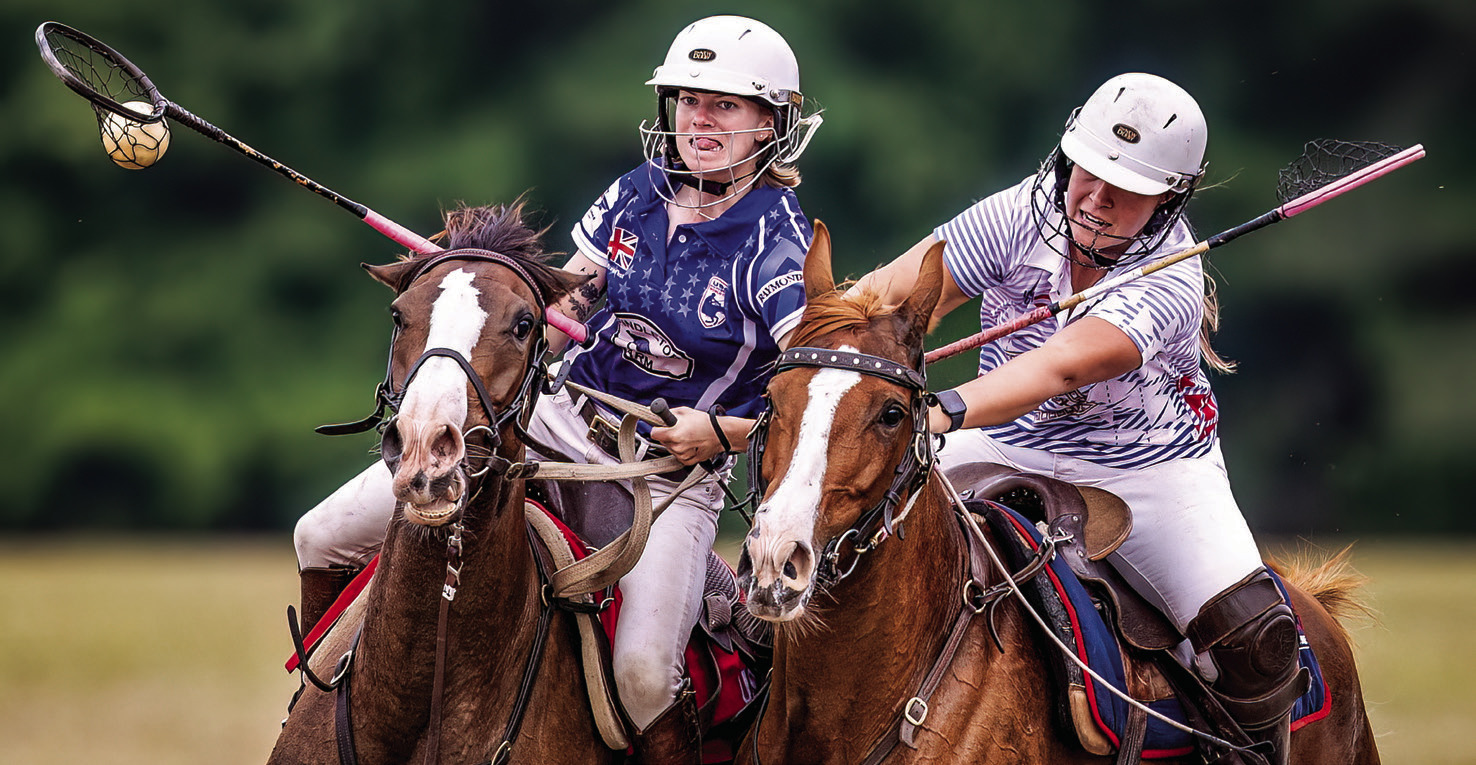
Aubrey Shuttles of the United States (left) clashes with Katie Woodward from the United Kingdom in a May match between the countries. After the match, Shuttles was recognized by the U.K. team as Best Lady Player. PHOTO BY JASON JACKSON OF JSK PHOTOGRAPHY LLC

Comment
Comments