
REAL ESTATE
HOUSE PRICES IN COUNTY AND REGION ON THE RISE AGAIN Buyers are ‘moving forward with confidence’
After a few years of harsh interest rates led to a decline in what sellers could get for a house, the market in Williamson County is heating up like a Texas summer afternoon.
This isn’t the blistering, bidding-war scenario that defined most of the Austinarea real estate scene in the opening years of the decade, but rather a gentle rise in prices, a significant increase in the number of sales and a tightening inventory.
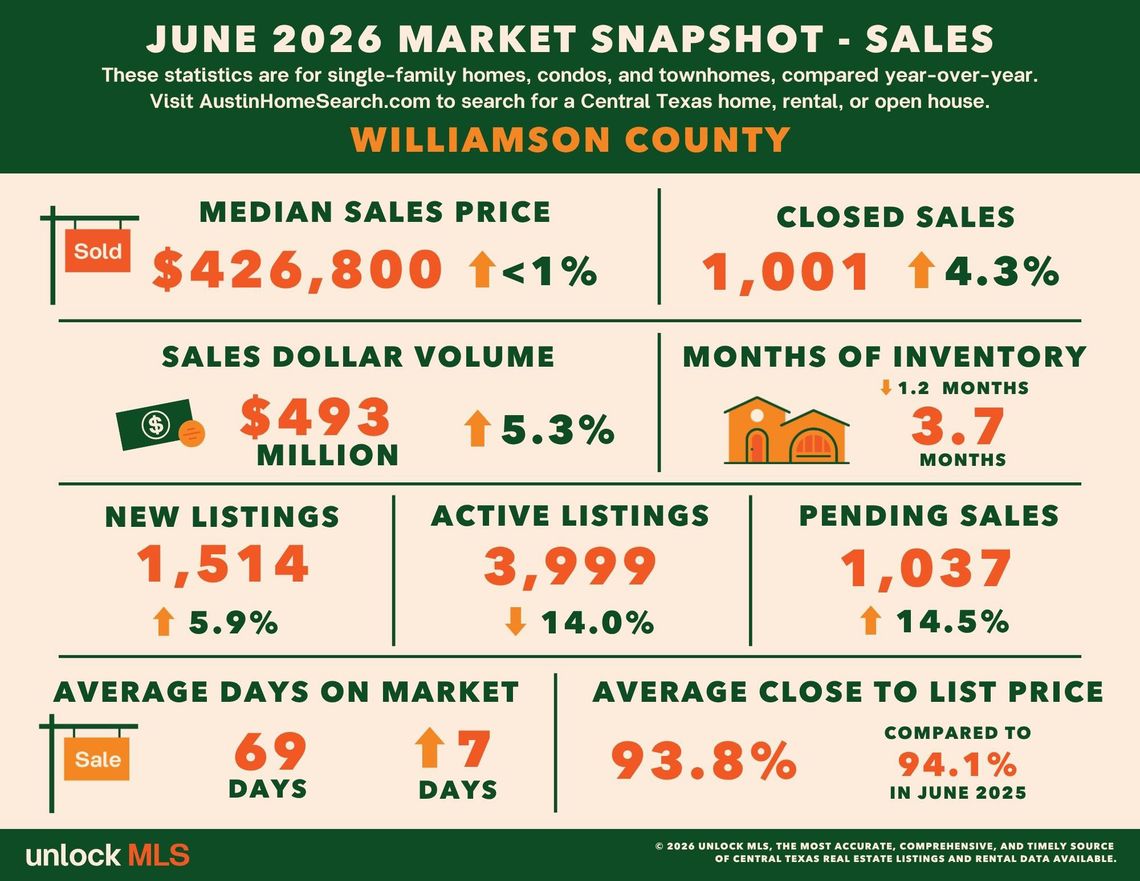
Williamson County posted the tightest inventory in the region in June, with just 3.7 months of housing stock on the market, or 1.2 months less than June 2025, according to data from Unlock MLS and the Austin Board of Realtors.
By comparison, the five-county Austin-Round Rock-San Marcos Metropolitan Statistical Area had just 4.4 months of inventory in June, a month less than same month last year.
That means that although interest rates as low as 3% are no longer driving the market, demand is coming back and buyers have adjusted to higher mortgage rates. At the end of July, average rates across the country rose to 6.58%, after declines earlier in the year got it closer to 6%.
“In June, we saw inventory tighten, homes sell more quickly and median prices increase year-over-year,” said Vaike O’Grady, market research advisor at Unlock MLS. “While we’ll need to continue to monitor these trends in the months ahead, these early signals suggest the market is continuing to build on the progress we’ve seen over the past year.”
CONFIDENCE IN EAST WILCO
East Williamson County remains even more a bargain.
The median sales price of a house in Taylor was less than $300,000 in May, compared to $359,000 in May 2022, according to home buying website Redfin.
For Hutto, the median sold price on 224 houses in May was nearly $345,000, Redfin reports. At its peak in June 2022, houses in the city sold at a median price $430,000.
Hutto ranked as the No. 12 best suburb of Austin to live in, according to Niche, a company that analyzes various data on the quality of schools and life. It was No. 125 out of 416 for the best suburb in Texas for young professionals. While it had an overall score of A-, the commute to jobs in the Austin area got a C+.
Thousands of occupations are coming to the eastern part of the county thanks to the $17 billion Samsung Electronics Co. Ltd. semiconductor foundry and research center, manufacturing and logistics hubs for Samsung suppliers and a growing number of technology companies from South Korea, Taiwan and Europe.
LOCAL SALES PRICES
The median sales price in Williamson County ticked up just 0.5% to $426,800 in June compared to the same time last year. Previous months, however, were softer making the median for the first six months of the year $408,000, a decline of 2.9% compared to the first half of 2025, according to data from Unlock MLS.
For the five-county MSA, the median price was down 2.4% to $425,000 in the first half of the year compared to the same period last year. But prices made a return in June, rising 1.1% from the same month last year, bringing the median cost of buying a house to $450,000.
HOUSE SALES
The number of houses in the process of being sold was also telling right out of the gate for the summer buying season.
“One of the strongest metrics that we continue to see is the growth in pending sales year-to-date.” O’Grady said. “Pending sales provide us with an early look at where the market is headed, and when they’re increasing alongside closed sales. It tells us buyers continue to move forward with confidence.”
She added, “This combination of transactions and moderating prices reflects a market that is creating opportunity for buyers, while sellers continue to find success by pricing and positioning their homes strategically for today’s market.”
ABoR and Unlock MLS President John Crowe said real estate agents can use data and research to help buyers find the best opportunities and help sellers do strategic pricing to get the best price in the face of market trends.
“Every market is local, and conditions can vary from one neighborhood to the next,” Crowe said.
Williamson County residential home sales accounted for more than a third of deals closed in the first half of the year with 5,410 houses sold, up 7% from the first six months of 2025.
June sales in Wilco were up 4.3% with 1,001 houses changing hands.
Pending sales for the month were strong, showing a 14.5% increase from last June at 1,037 houses waiting for the signing of closing papers.
Residential real estate inside the Austin city limits remains the steepest followed by Travis County, a factor driving more home sales and subdivision development to Williamson, Bastrop, Caldwell and Hays counties.
The median price of a house sold in Austin in June was $605,000, an increase of 3.6% from June of last year. That’s a significant leap compared to sales prices earlier in the year. In the first six months, the median sales price inside the city limits was $572,500, a slight decline from the year before.
That price is inching toward the $615,000 median price for Austin in June of 2022, just one month after the record high of $667,000.
This is in part shaped by a market trying to find its footing in an economy marked by the continual rise of inflation, an uncertain future with on-again, off-again tariffs on goods from other countries and higher gas prices brought on by a months-old war and sometimes stalemate with Iran.
However, the rising price of housing and increase in demand also show another dynamic at play: confidence in future earnings in the local job market.
“The continued increase in home sales reflect growing confidence among Central Texas buyers,” said JC San Pedro, chief lending officer at Austin-based Amplify Credit Union. “As the market continues to build momentum, buyers who are financially prepared are well positioned to take advantage of increased inventory, more balanced pricing and greater negotiating opportunities.” As the high cost of buying a house remains a major concern for those living in and around Austin, real estate professionals are pointing the finger at factors other than price in making home ownership more difficult.
AFFORDABILITY STRAINS
A report released July 28 found that property taxes, homeowners insurance, utility rates and other costs associated with owning a home – the monthly housing carrying cost – is problematic for existing homeowners.
The 2026 Central Texas Homeowner Affordability Index from Unlock MLS and the Austin Board of Realtors concluded that for every additional $100 a month in costs related to home ownership, about 9,800 Central Texas households find themselves costburdened. That is reached when housing costs, including the mortgage payments, exceed 30% of the gross household income.
The estimated baseline cost of homeownership in Williamson County is pegged at $2,156 a month. In Travis County that number is $2,516 a month, while the more sparsely populated Caldwell County has the lowest cost in the MSA at $1,524.
Adding $100 a month to those figures would cost-burden about 4,500 Travis County residents, 3,000 in Williamson County and another 2,300 across the other three counties included in the region.
ABoR officials want community leaders and lawmakers to consider these factors when deciding on things such as issuing new bonds that require additional taxation or raising the rates on everything from picking up the garbage to water usage. Since 2019, the increase in mortgage payments, property taxes, insurance and utilities have outpaced the increase in median incomes in Central Texas.
“Many existing owners are protected by sub-4% mortgages and homestead appraisal caps, but those protections do not touch monthly carrying costs,” according to the study’s authors. “The result is a quiet, cumulative strain on Central Texas households that is slowly impacting our communities and broader economy.”
While Austin ISD is seeing declining numbers and Austin is experiencing an outmigration of residents, some people are moving to the Houston or Dallas areas. But the suburbs are the first to feel the population gain.
“Households, workers, and economic activity are shifting toward lower-cost destinations outside of the region’s urban core. Most of that movement has stayed within the broader Central Texas region, which is a positive sign for our suburban counties but can present their own challenges for public school districts as those families bring their children with them,” according to the study.

Comment
Comments